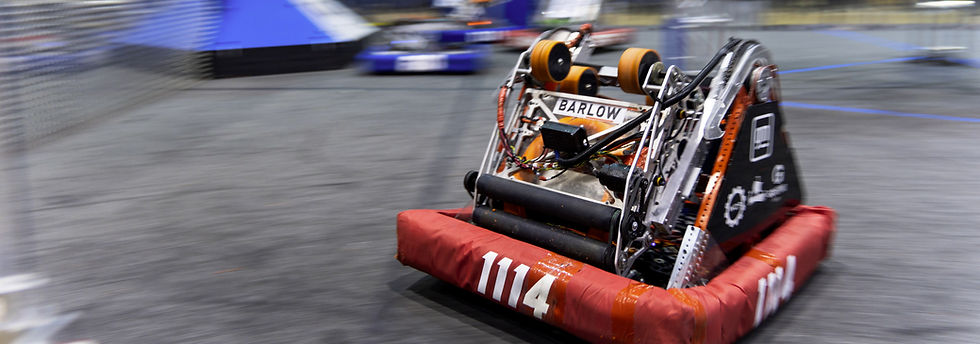
Drivetrain Selection
Purpose of a Drivetrain
- Move around field
- Typically 27' x 54' carpeted surface
- Push/Pull Objects and Robots
- Climb up ramps or over/around obstacles
- Most important sub-system, without mobility it is nearly impossible to score or prevent points
- Must be durable and reliable to be successful
- Speed, Pushing Force, and Agility important abilities
Types of Wheels
- "Traction" Wheels
- Standard wheels with varying amounts of traction, strength & weight
- Kit of Parts (KOP)
- AndyMark (AM) or VEX Pro
- Pneumatic
- Slick
- Custom
- Omni
- Rollers are attached to the circumference, perpendicular to the axis of rotation of the wheel
- Allows for omni directional motion
- Mecanum
- Rollers are attached to the circumference, on a 45 degree angle to the axis of rotation of the wheel
- Allows for omni directional motion
Types of Drivetrains
- Tank
- Swerve
- Slide
- Mecanum
- Holonomic
Types of Drivetrains: Tank
- Left and right wheel(s) are driven independently
- Typically in sets of two (1-4 sets is common, sometimes higher)
- Strengths
- Simple & cheap to design, build, and program
- Easy to drive
- Potential for high speed and/or pushing force
- Weaknesses
- Slightly less agile than other drivetrains
Types of Drivetrains: Swerve/Crab
- Wheels modules rotate on the vertical axis to control direction
- Typically 4 traction wheels
- Strengths
- Potential for high speed and/or pushing force
- Agile
- Weaknesses
- Very complex and expensive to design, build and program
- Extra motors required to be able to rotate robot frame
Types of Drivetrains: Slide
- Similar layout to tank drive, with an extra wheel(s) perpendicular to the rest
- Must use all omni wheels
- Strengths
- Fairly easy and cheap to design, build, and program
- Agile
- Weaknesses
- No potential for high pushing force
- Extra wheel(s)/motor(s)/gearbox(es) required to allow robot translate sideways
Types of Drivetrains: Mecanum
- Similar layout to tank drive, but each wheel must be driven independently
- Must use 4 mecanum wheels
- Strengths
- Fairly easy to design & build
- Agile
- Weaknesses
- No potential for high pushing force
- Challenging to program and learn to drive well
- Requires extra gearboxes
- Wheels are expensive
Types of Drivetrains: Holonomic
- 4 omni wheels positioned on 45 deg angle in the corners of the frame
- Each wheel must be driven independently
- Strengths
- Weaknesses
- No potential for high pushing force
- Very challenging to program and learn to drive well
- Requires extra gearboxes
Compare Drivetrains
- Choosing the right drivetrain is critical to the success of an FRC robot
- Several drivetrains to choose from
- Each one has its own strengths and weaknesses
- Important to quantitatively evaluate all options to ensure optimal solution is chosen
- Best method to do this is a "Weighted Objectives Table"
Drivetrain Attributes
- Agility
- Ability to translate in the x and y axis as well as rotate about the z axis simultaneously
- Strength
- Push robots and/or game pieces
- Resist defense from all sides of the drivetrain
- Number of Motors
- Number of motors allowed on an FRC robot is limited
- Most drivetrains use 4 CIM motors to power wheels
- Additional motors to rotate wheel modules or translate sideways may take away from motors for other robot functions
- Programming
- Ideally does not require sensor feedback (eg. wheel module angle)
- Ideally does not require advanced algorithm to calculate individual wheel speed/power
- Ease to Drive
- Intuitive to control so little practice is required to be competitive
- Just because some drivetrains have the ability to move sideways doesn’t mean the driver will use the ability
- Often drivers end up turning the robot because it is more natural or going sideways feels (or actually is) slower
- Traverse Obstacles
- The ability of a drivetrain to traverse ramps, bumps or steps
- Design
- This is a very general heading. Sub headings grouped as there is a strong relationship between them
- Cost
- Ease to design (select components and choose dimensions)
- Ease to manufacture
- Ease to assemble
- Ease to maintain/repair
- Weight
Weighted Objectives Tables
- Give each attribute of each drivetrain a relative score between 1 and 5
- Weights are dependant on
- Strategic analysis of the game (priority list)
- Teams resources
| | Weight | Tank | Swerve | Slide | Mecan | Holo |
| Agility | ? | 3 | 5 | 5 | 5 | 5 |
| Strength | ? | 4 | 5 | 1 | 1 | 1 |
| Motors | ? | 5 | 1 | 3 | 5 | 5 |
| Program | ? | 5 | 1 | 4 | 3 | 2 |
| Drive | ? | 5 | 3 | 3 | 2 | 1 |
| Traverse | ? | 5 | 4 | 4 | 3 | 1 |
| Design | ? | 5 | 1 | 4 | 4 | 3 |
- Agility, Strength & Ability to traverse obstacles
- Relative to #1 priory, reliability
- 0 = not important or required
- 10 = equally as important as reliability
- Number of Motors
- Depends on complexity of other robot features and ability to design with all motors
- 0 = no other features/very strong ability to design with all motors
- 10 = very complex/little ability to design with other motors
- Programming
- Depends on strength of programming team (# of students/mentors, experience, ect)
- Ease to Drive
- Depends on amount of available practice
- 0 = have a full practice field and practice robot with committed drivers that train every day
- 10 = no practice field/robot, no time in build season to practice
- Design
- How many students/mentors do you have?
- How much experience do you have?
- What tools are available to you (hand tools < bandsaw < mill)?
- How many hours are your shop facilities available/will you use them?
- How much money do you have?
- Drivetrains with a low design score require significant resources to design a reliably
- 0 = lots of experience, students, mentors, tools, money
- 0 = The desired drivetrain has been used in a previous season or prototyped in the off season
- 10 = No experience, few students, mentors, tools, money
Typical Weights for a Rookie or Low Resource Team
- 5 - Agility
- 5 - Strength
- 5 - Number of Motors
- 10 - Programming
- 10 - Ease to Drive
- 0 - Traverse Obstacles
- 10 - Design
- Resources are low, so it is more important to build a simple drivetrain that is easy to program and learn how to drive to ensure reliability.
- The performance of the drivetrain (agility & strength) are not as important as reliability
- The number of motors is not as important because additional features should be very basic and require few (or no) motors
Rookie/low Resource Team Weighted Table
- Rookie/low resource team weighted table
- Tank drivetrain much higher score than others
- Slide drive second best
| | Weight | Tank | Swerve | Slide | Mecan | Holo |
| Agility | 5 | 3 (15) | 5 (25) | 5 (25) | 5 (25) | 5 (25) |
| Strength | 5 | 4 (20) | 5 (25) | 1 (5) | 1 (5) | 1 (5) |
| Motors | 5 | 5 (25) | 1 (5) | 3 (15) | 5 (25) | 5 (25) |
| Program | 10 | 5 (50) | 1 (10) | 4 (40) | 3 (30) | 2 (20) |
| Drive | 10 | 5 (50) | 3 (30) | 3 (30) | 2 (20) | 1 (10) |
| Traverse | 0 | 5 (0) | 4 (0) | 4 (0) | 3 (0) | 1 (0) |
| Design | 10 | 5 (50) | 1 (10) | 4 (40) | 4 (40) | 3 (30) |
| Total | 225 | 93% (210) | 47% (105) | 69% (155) | 64% (145) | 51% (115) |
Comparison of weighted tables for different resource teams
| | Rookie | Average | Strong |
| Agility | 5 | 8 | 10 |
| Strength | 5 | 8 | 10 |
| Motors | 5 | 6 | 5 |
| Program | 10 | 7 | 3 |
| Drive | 10 | 7 | 3 |
| Traverse | 0 | 0 | 0 |
| Design | 10 | 7 | 3 |
| | Tank | Swerve | Slide | Mecan | Holo |
| Rookie | 93% | 47% | 69% | 64% | 51% |
| Average | 89% | 56% | 67% | 66% | 56% |
| Strong | 82% | 71% | 64% | 66% | 61% |
When to choose a swerve drive
- Strength & Agility equally as important as reliability
- Lots of students/mentors
- Access to advanced tooling
- Large budget
- Team has strong ability to use other motors for robot function
- Team has practice field and practice robot
- Team has used a swerve in a previous season, or prototyped one in the off season
| | Swerve |
| Agility | 10 |
| Strength | 10 |
| Motors | 2 |
| Program | 2 |
| Drive | 2 |
| Traverse | 0 |
| Design | 2 |
| | Tank | Swerve | Slide | Mecan | Holo |
| Swerve | 79% | 80% | 63% | 63% | 59% |
When to choose a slide drive
- Agility equally as important as reliability
- Strength is not required (game has no interaction with opponents)
- Team has practice field and practice robot
- Team has used a slide in a previous season, or prototyped one in the off season
- Lots of students/mentors
- Team has strong ability to use other motors for robot function
| | Slide |
| Agility | 10 |
| Strength | 0 |
| Motors | 1 |
| Program | 3 |
| Drive | 1 |
| Traverse | 0 |
| Design | 3 |
| | Tank | Swerve | Slide | Mecan | Holo |
| Slide | 78% | 67% | 89% | 87% | 79% |
When to choose a mecanum drive
- Agility equally as important as reliability
- Strength is not required (game has no interaction with opponents)
- Team has practice field and practice robot
- Team has used a mecanum in a previous season, or prototyped one in the off season
- Strong programing ability
- Lots of students/mentors
| | Mecan |
| Agility | 10 |
| Strength | 0 |
| Motors | 5 |
| Program | 2 |
| Drive | 2 |
| Traverse | 0 |
| Design | 3 |
| | Tank | Swerve | Slide | Mecan | Holo |
| Mecan | 82% | 60% | 83% | 88% | 82% |
Designing a Tank Drivetrain
- At this point we have concluded Tank-Style Drivetrain is usually the best option for all teams, regardless of the game or the teams resources
- Why don’t all teams use Tank-Style Drivetrains?
- Some (few) teams have a lot of resources
- Trying new things to learn new skills/gain new experiences
- Understanding this choice will make them less competitive
- Improper strategic analysis of the game and evaluation of team resources
- Improper analysis of strengths and weakness of various drivetrains
- Omni directional drivetrains have a significant "cool factor" that distract teams